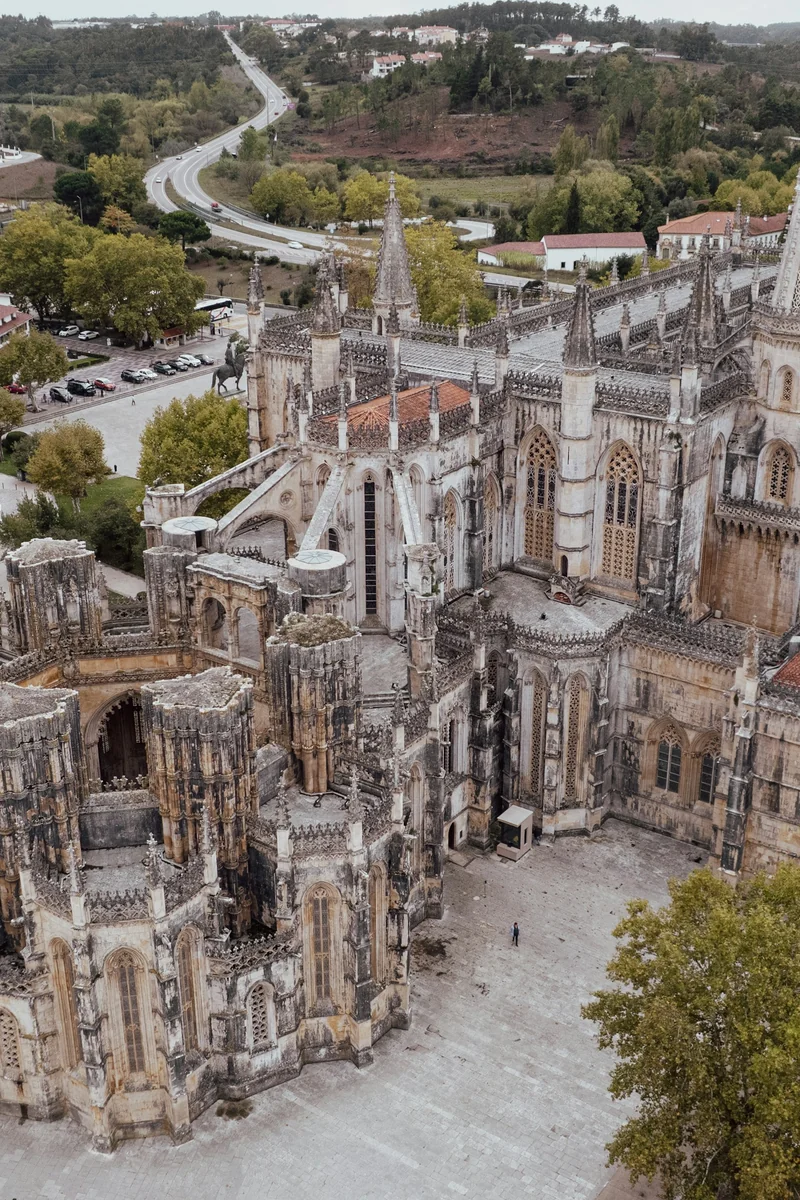
Where a kingdom kept its vow
Mosteiro de Santa Maria da Vitória — the Dominican abbey King João I raised after the 1385 Battle of Aljubarrota saved Portuguese independence. Two centuries of carved limestone, the Founder's Chapel tombs, and the roofless Capelas Imperfeitas that no king ever finished.
Get your Batalha Monastery ticket- UNESCO World Heritage Site, 1983 — Portuguese late-Gothic masterpiece
- 1386 Foundation laid by King João I after Aljubarrota
- 2 centuries Continuous construction under seven Portuguese kings
- Unfinished Capelas Imperfeitas — the open-sky octagon Manuel I abandoned
Tickets and tours for Mosteiro de Santa Maria da Vitória
Compare the best-rated ways to visit, check live availability and book in a few taps.
- Top pick
Batalha Monastery Entrance Ticket
Skip-the-line entry to the church, the Founder's Chapel, the Royal Cloister and the Unfinished Chapels, with free cancellation up to 24 hours ahead.
From US$16Check availability ↗ Batalha Monastery: Private Tour
A 2-hour private guided visit of the royal pantheon of King João I, Queen Philippa and Henry the Navigator, and the story of Aljubarrota.
From US$49Check availability ↗Batalha Monastery Local's Tour + Skip-the-Line Tickets
A 1.5-hour visit with a local guide and skip-the-line monastery tickets included.
From US$99Check availability ↗From Lisbon: Fátima, Nazaré, Batalha & Óbidos Guided Tour
A full guided day from Lisbon that pairs Batalha Monastery with the Sanctuary of Fátima, Nazaré's giant waves and medieval Óbidos.
From US$32Check availability ↗
More things to do nearby
About Mosteiro de Santa Maria da Vitória
Mosteiro da Batalha was founded by King João I of Portugal in fulfilment of a vow made before the Battle of Aljubarrota on 14 August 1385 — a battle in which a Portuguese force, outnumbered roughly three to one, defeated the Castilian army of Juan I and secured the independence of the new House of Avis. The king had promised the Virgin Mary that, if granted victory, he would build her a Dominican abbey. Construction began the year after the battle and continued under seven successive Portuguese monarchs for more than 150 years.
Architecturally, Batalha is the most ambitious flowering of Portuguese late-Gothic. The earliest phases — the church, the Royal Cloister, the Founder's Chapel — were directed by the master mason Afonso Domingues from 1388, followed by Huguet, who introduced the more flamboyant tracery and the octagonal Founder's Chapel. Later generations added the Cloister of King Afonso V and, under King Duarte, the rear octagonal chapels that came to be known as the Capelas Imperfeitas — the Unfinished Chapels — when Manuel I redirected royal building funds to Mosteiro dos Jerónimos in Lisbon and the work at Batalha was abandoned with the upper vaults open to the sky.
Inside the Founder's Chapel lie the joint tomb of João I and his queen Philippa of Lancaster — daughter of John of Gaunt and a granddaughter of Edward III of England — and the tombs of four of their sons, including Prince Henry the Navigator. The marriage of João I to Philippa in 1387 sealed the Anglo-Portuguese Alliance, the oldest active diplomatic treaty in the world. UNESCO inscribed the monastery as a World Heritage Site in 1983, citing it as a masterpiece of Gothic art and an exceptional document of late-medieval Portuguese national identity.
Look closely and Batalha rewards the patient visitor. The chapter house holds Portugal's Tomb of the Unknown Soldiers under a vast star-vault so daring for its day that, by tradition, only prisoners would finish it — and an hourly change of guard still takes place beneath it. The carved limestone darkens and pales with the weather, and the roofless Capelas Imperfeitas frame open sky above sculpted stone. Booking Batalha Monastery tickets ahead lets you arrive in the calm first hour and read it unhurried.
Practical information
- Address
- Largo Infante Dom Henrique, 2440-109 Batalha, Portugal
- Getting there
- Batalha is roughly 120 km north of Lisbon and 80 km south of Coimbra, just off the A1 motorway via the A19. By bus: Rede Expressos runs daily coaches from Lisbon (Sete Rios) and Porto in roughly 2 hours; the Batalha terminal is a 5-minute walk from the monastery. No train station in Batalha itself — closest is Leiria, then taxi or bus. Most independent visitors arrive by rental car or as part of a Lisbon–Fátima–Nazaré day-trip routing.
- Time needed
- Weekday mornings (first hour of opening) are the calmest window. Mid-morning brings coach-tour groups from Lisbon. Open daily year-round. The full visit — church, Founder's Chapel, both cloisters, chapter house and Capelas Imperfeitas — takes 75–90 minutes at a steady pace.
- What to wear
- Comfortable shoes (uneven limestone underfoot). The church is largely indoor / covered; the Capelas Imperfeitas are open to the sky and exposed to rain. The Royal Cloister catches the morning sun beautifully on clear days. A light layer is useful even in summer because the church interior runs cool.
- Accessibility
- The church nave, Founder's Chapel and the ground floor of both cloisters are level. Some thresholds have small steps. The Capelas Imperfeitas are reached via an external passage with a low ramp; the inner octagon floor is level.
Plan your visit
Practical guides written by our travel team
Best Time to Visit the Monastery of Batalha
When the Royal Cloister catches the sun, the Unfinished Chapels feel deserted, and the coach-tour wave hits.
How to Get to Batalha Monastery from Lisbon
By car, intercity bus, organised tour — the four routes from Lisbon to Batalha compared on time, cost and convenience.
Batalha Monastery — Why It Was Built (The Battle of Aljubarrota)
The 1385 victory that defined Portuguese independence, the king who built a monastery to keep the vow, and 150 years of construction history.
Frequently asked
What was the Battle of Aljubarrota?
A decisive battle fought on 14 August 1385 between Portugal and Castile, a few kilometres south of Batalha. A Portuguese force led by King João I and his constable Nuno Álvares Pereira defeated a larger Castilian army, ending the 1383–85 Portuguese succession crisis and securing Portugal's independence from Castile. The monastery was João I's thanksgiving vow to the Virgin Mary for the victory.
Who is buried in the Founder's Chapel?
King João I and his English queen Philippa of Lancaster lie in a joint tomb in the centre of the chapel, their effigies hand-in-hand. Around them are the tombs of four of their sons, including Prince Henry the Navigator — patron of the early Portuguese voyages of discovery — and Prince Pedro. The chapel is an octagonal star-vaulted space, the earliest royal mausoleum of its kind in Portugal.
Why are the Capelas Imperfeitas unfinished?
King Duarte commissioned the octagonal rear chapel around 1437 to serve as his own pantheon, but he died of plague in 1438 before the work was far advanced. Successive kings continued in fits and starts; the elaborate carved limestone reached the springing of the vaults but the dome was never built. When King Manuel I redirected royal building funds to Mosteiro dos Jerónimos in Lisbon in the early 1500s, the work at Batalha was abandoned. The upper octagon remains open to the sky.
Is Batalha the same place as Fátima?
No. Batalha and Fátima are two separate sites about 20 km apart in central Portugal. Batalha is a 14th-century Dominican monastery and UNESCO World Heritage Site. Fátima is a 20th-century Marian pilgrimage shrine. Many coach tours combine both in a single day-trip from Lisbon — they are an easy pair to do together.
How long does a visit take?
Most visitors spend 75–90 minutes inside. The church and Founder's Chapel deserve 25–30 minutes; the Royal Cloister another 20; the chapter house and the Cloister of Afonso V around 15; the Capelas Imperfeitas a final 15–20. Photographers and history readers often spend two hours.
What's the best time of day to visit?
First hour of opening, Tuesday to Friday. The Royal Cloister catches the morning sun through its tracery beautifully before 11:00, and the coach-tour groups travelling the Lisbon–Fátima–Nazaré circuit have not yet arrived. Mid-morning to early afternoon is the busiest window. Last 90 minutes before close is the second-best quiet period.
Is the church still active?
The Dominican community at Batalha was dissolved in 1834 along with all Portugal's religious orders. The church (Igreja de Santa Maria da Vitória) is no longer a parish but remains consecrated and is used for occasional services. Most of the year it functions as part of the monument visit.
Can I take photographs inside?
Yes, for personal use, without flash and without a tripod. The Founder's Chapel and the Royal Cloister are the most photographed spaces. The Tomb of the Unknown Soldiers area has the additional constraint that you should not photograph the guards in a way that disrupts the change-of-guard ceremony.
What if my visit date is rainy?
The church, Founder's Chapel, both cloisters and the chapter house are all covered. The only exposed space is the Capelas Imperfeitas — the rear octagonal chapel — which is open to the sky. In heavy rain you can still see it from the doorway but the floor will be wet. The rest of the visit is comfortable in any weather.
Is there parking at the monastery?
Yes — a free public car park sits about 200 metres east of the main entrance, with overflow parking in marked bays around the square. Coach parking is on a separate dedicated lot. The car park fills from mid-morning on summer weekends and during peak Fátima pilgrimage periods (especially the 12th–13th of each month from May to October).
What is Mosteiro de Santa Maria da Vitória?
Mosteiro de Santa Maria da Vitória, widely known as the Monastery of Batalha or Mosteiro da Batalha, is a Dominican monastery in the town of Batalha, in the Leiria district of central Portugal. King João I founded it in 1386 to honour a vow made before the Battle of Aljubarrota, the 1385 engagement that secured Portuguese independence from Castile. Construction continued under seven successive reigns for more than a century and a half, producing one of Europe's foremost works of late-Gothic and Manueline architecture. The complex includes the Founder's Chapel, where João I and his queen Philippa of Lancaster lie alongside their sons, among them Henry the Navigator; the Royal Cloister; the chapter house; and the roofless Capelas Imperfeitas, or Unfinished Chapels, left open to the sky when royal funds were redirected to Lisbon. UNESCO inscribed it as a World Heritage Site in 1983.
How do I get to Mosteiro de Santa Maria da Vitória?
The monastery stands in the centre of the town of Batalha, in the Leiria district of central Portugal, roughly 120 kilometres north of Lisbon. There is no railway station in Batalha itself; the nearest line runs through Leiria, about 15 kilometres away, from where regional buses and taxis complete the journey. Direct long-distance coaches link Lisbon with the Batalha terminal in around two hours, and the monastery sits within a short walk of the stop. Local services also connect Batalha with Leiria in under twenty minutes. By road, drivers reach the town via the A1 motorway and the A19, or the IC2, with the site clearly signposted from the surrounding routes. A large public car park lies close behind the monastery, and parking in the town is generally straightforward outside the busiest summer mornings and pilgrimage periods.
How does booking work on this site?
This site is an independent visitor guide to Mosteiro de Santa Maria da Vitória. When you choose a ticket or tour, you book it directly with GetYourGuide, which takes the payment, issues the ticket and handles any changes or cancellations. We may earn a commission when you book, at no extra cost to you.