 Skip-the-line available
 Batalha Monastery — Why It Was Built (The Battle of Aljubarrota)
The 1385 victory that defined Portuguese independence, the king who built a monastery to keep the vow, and 150 years of construction history.
Batalha Monastery exists because of one battle. On 14 August 1385, a Portuguese army led by João, Master of Avis, defeated a Castilian invasion at Aljubarrota — securing Portuguese independence and putting João on the throne as the first king of the House of Avis. He had vowed before the battle to build a monastery if he won. He kept the vow: construction at Batalha began in 1386 and continued for 150 years.
The battle and the vow — 1385
The Battle of Aljubarrota (14 August 1385) was fought between a Castilian army of perhaps 30,000 and a smaller Portuguese force led by João, Master of Avis, allied with English archers under Sir John Hawkwood and Sir Henry Hartsell. The English-Portuguese coalition decisively defeated the Castilians; the battle secured the legitimacy of João's claim to the Portuguese throne and prevented the kingdom from being absorbed into Castile-León.
Before the battle João had publicly vowed to build a great monastery dedicated to the Virgin Mary if he won. He fulfilled the vow: construction began the following year, 1386, at a site 16 km from the battlefield. The dedication is Santa Maria da Vitória (Saint Mary of the Victory). Henrique, the architect, was appointed to lead the works; the monastery was placed in the care of the Dominican Order.
150 years of construction — 1386 to 1533
Construction continued for 150 years across the reigns of seven Portuguese kings. The main church was completed first (consecrated 1402). The Founder's Chapel (Capela do Fundador) was added between 1426 and 1434 by King Duarte for his father João I — it holds the tombs of João, Philippa of Lancaster (his English queen), and four of their five sons including Henry the Navigator. The Royal Cloister was completed mid-15th century. The Chapter House (with its later Tomb of the Unknown Soldier) was added in 1402 with its remarkable single-span Gothic vault — a feat of engineering for its time.
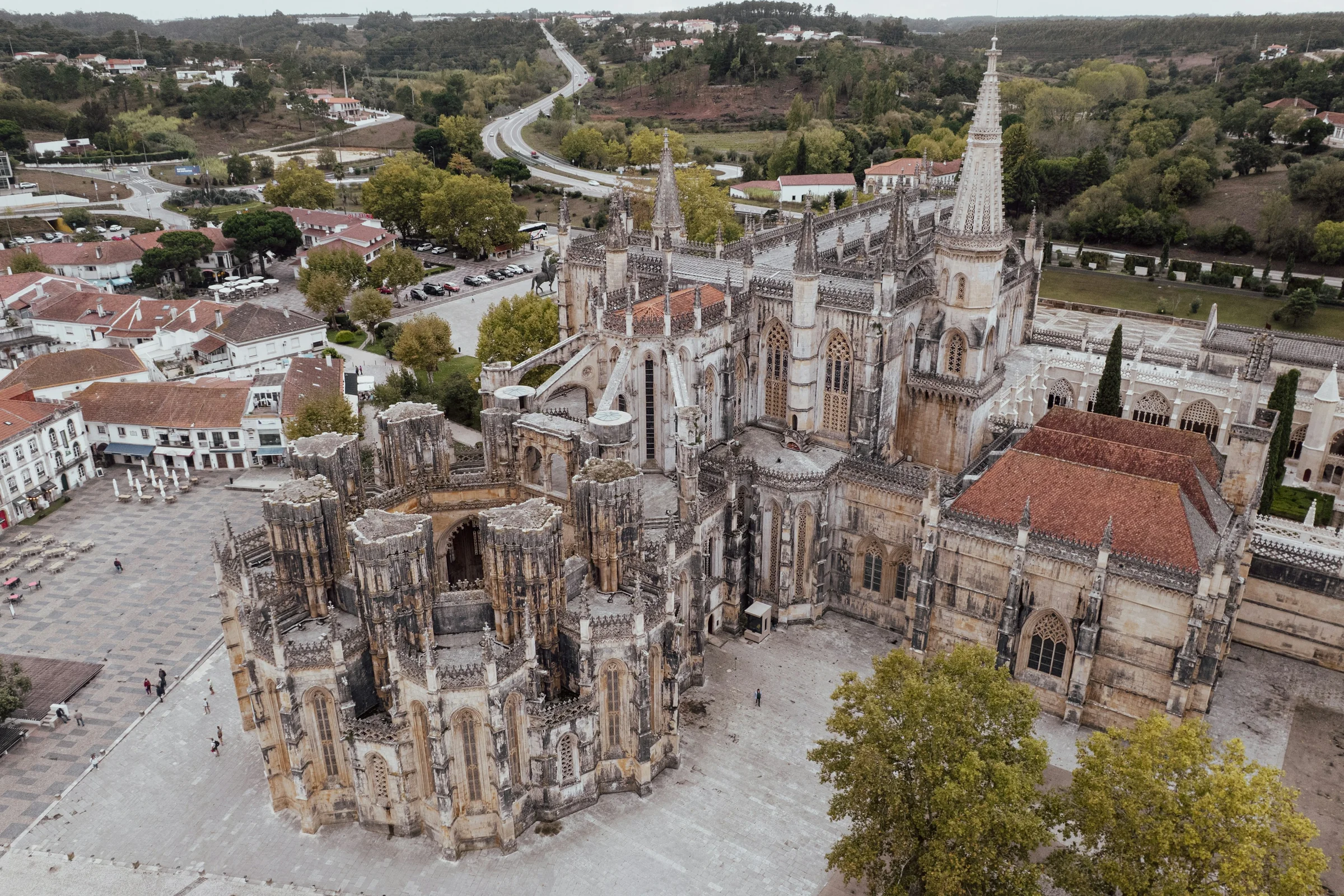
The Capelas Imperfeitas (Unfinished Chapels) at the east end were begun in 1437 by King Duarte but never completed. Manuel I (king 1495–1521) added the Manueline-Gothic decoration to the cloister arches — the most ornate phase of the building's history. Construction stopped in 1533 with the Unfinished Chapels' planned dome never built; the space stands open to the sky to this day.
The Tomb of the Unknown Soldier
The Chapter House at Batalha houses the Tomb of the Unknown Soldier (Túmulo do Soldado Desconhecido), a memorial to all Portuguese servicemen killed in World War I (1917–1918, on the Western Front in France and in Africa). Two unidentified Portuguese soldiers were buried here in 1921 — one from Africa, one from Flanders — beneath an eternal flame that has burned continuously since.
The placement in the Chapter House is intentional: the room's medieval Gothic vault (engineered by Master Afonso Domingues in 1402) is the largest single-span Gothic vault in the world, an architectural feat unmatched at its time. Generations of Portuguese have associated the memorial with the same heroic-national narrative as the medieval monastery. The eternal flame and a permanent honour guard are maintained by the Portuguese Army.
UNESCO inscription and the modern site
Batalha was declared a National Monument by Portugal in 1907 and inscribed by UNESCO as a World Heritage Site in 1983 — the second Portuguese site (after Belém Monastery in 1983) to receive World Heritage status. The Dominican community at Batalha was dissolved in 1834 when the Portuguese liberal government closed all male religious orders; the buildings passed to state ownership.
Restoration work has continued through the 20th and 21st centuries, with major campaigns in the 1930s, 1970s, and 2010s. The site is now open year-round; the Tomb of the Unknown Soldier and the eternal flame remain a place of national commemoration on 11 November (Armistice Day) and 10 June (Portugal Day). Approximately 250,000 visitors come each year.
Frequently asked
Why is Batalha Monastery called the Monastery of the Victory?
Its full name is Mosteiro de Santa Maria da Vitória — Monastery of Saint Mary of the Victory. It was built by King João I to fulfil a vow he made before the 1385 Battle of Aljubarrota, where the Portuguese defeated a Castilian invasion and secured Portuguese independence.
What is the Battle of Aljubarrota?
A decisive battle on 14 August 1385 in which a Portuguese army under João, Master of Avis, supported by English archers, defeated a larger Castilian invasion. The victory secured Portuguese independence and made João king, founding the House of Avis dynasty. Batalha Monastery was built to commemorate the victory.
How long did it take to build Batalha Monastery?
About 150 years, from 1386 to 1533. Construction spanned the reigns of seven kings — João I, Duarte, Afonso V, João II, Manuel I, João III. The Founder's Chapel was built 1426–1434, the Royal Cloister mid-15th century, the Manueline decoration added 1495–1521 by Manuel I. The Capelas Imperfeitas were never completed.
Who is buried at Batalha?
In the Founder's Chapel: João I (founder), Philippa of Lancaster (his English queen), and four of their five sons — Duarte (later king), Pedro, João, and Fernando (the Saintly Infante). Also Henry the Navigator (Infante Dom Henrique, the prince who launched Portuguese maritime exploration). The Chapter House holds the Tomb of the Unknown Soldier from WWI.
When was Batalha made a UNESCO site?
1983. The inscription covers the entire monastery complex — the main church, the Founder's Chapel, the Royal Cloister, the Chapter House and the Unfinished Chapels. Batalha was one of the first Portuguese sites to receive UNESCO status.
Is Batalha still a working monastery?
No. The Dominican community was dissolved in 1834 when the Portuguese government closed all male religious orders. The buildings became state property and are now a heritage site managed by the site authority. The Tomb of the Unknown Soldier in the Chapter House is a place of state-level commemoration on national days.