 Skip-the-line available
 Batalha Royal Cloister — Manueline Arches Detail Guide
The Royal Cloister's late-Gothic columns were transformed by Manuel I's master sculptors into one of Iberia's finest stone-carving cycles. What to look for, arch by arch.
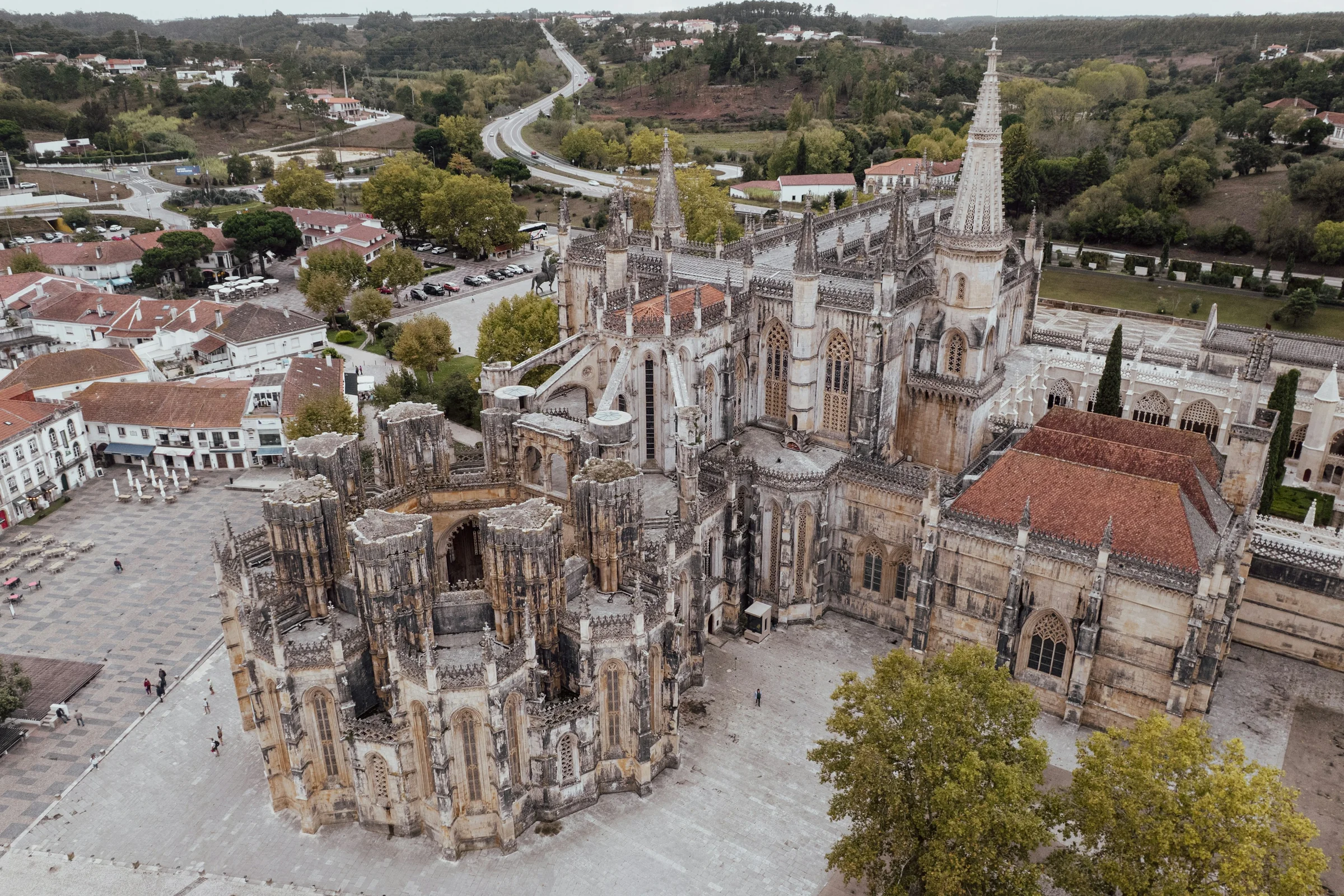
The Royal Cloister (Claustro Real) at Batalha is where the monastery's most ornate stonework concentrates. The basic structure is 15th-century Gothic, but the spectacular carved decoration around the arches was added in the Manueline phase under Manuel I (1495–1521). This guide is a close walk around the cloister, arch by arch, with what to look for in the carving programme.
The structure — Gothic core + Manueline decoration
The Royal Cloister was originally built between 1402 and the mid-15th century in straightforward Iberian Gothic — pointed arches, plain piers, austere proportions. The transformation came in the reign of Manuel I (king 1495–1521), when court sculptor Mateus Fernandes (who also worked on the Capelas Imperfeitas) added elaborate carved tracery to the arch openings. The pre-existing piers were retained; the additions are infill panels of stone tracery that fill the original arch openings with intricate Manueline motifs.
This double-stratum effect — austere Gothic structure plus virtuoso Manueline ornament — is what makes the Royal Cloister visually distinctive. It is one of the major Manueline cycles in Portugal, comparable to the Jerónimos cloister in Belém. The two cloisters are often visited together as a study in late-Gothic Portuguese stone-work.
The carving programme
Each Manueline arch panel features layered carving with the following recurring motifs. Maritime references reflect Portugal's Age of Discovery, then at its height: ropes (cabos), anchors (âncoras), armillary spheres (esferas armilares — the personal emblem of Manuel I), and small sailing ships. Vegetal motifs include twisting branches, oak leaves, vines and fruit. Royal heraldry features the Portuguese coat of arms and Manuel I's personal arms.
Each panel is unique — Mateus Fernandes and his workshop carved them as a sequence with subtle variations. Take 10–15 minutes to walk the cloister slowly and compare adjacent panels; the differences in detail are the work's reward. The east and south sides catch best morning light; the west and north sides best afternoon light. Photography is permitted without flash; close-up phone photos pick up the detail well.
The lavabo and washhouse
In the south-west corner of the cloister stands the lavabo (washhouse) — a small octagonal pavilion where Dominican monks washed before entering the refectory. The lavabo has its own carved Manueline decoration and a small fountain in the centre. The space is often overlooked by visitors hurrying through the cloister; the careful Manueline carving on its small interior arches is worth 5–10 minutes of close inspection.
The refectory itself opens off the cloister on the south side. The space is now used for occasional temporary exhibitions; the medieval refectory furniture is long gone. The wall where the monks' table stood is identifiable from the position of the lavabo opposite.
How the Royal Cloister compares to Jerónimos
The Royal Cloister at Batalha (1495–1521 Manueline phase) and the Jerónimos Monastery cloister in Belém (1502–1544) are the two great Portuguese Manueline cloisters. Both share the layered Gothic-structure-plus-Manueline-ornament approach. Batalha is the older work and shows tighter, more controlled carving; Jerónimos is the later and shows more exuberant, free decoration with more pronounced maritime references.
Visitors comparing the two often prefer one or the other based on individual taste. Art-history convention treats them as complementary — Batalha as the foundational Manueline cloister, Jerónimos as the climactic statement. Visiting both in succession (on different days or weekend trips) is the strongest way to understand the Manueline style as a whole.
Frequently asked
Who built the Manueline decoration at Batalha's Royal Cloister?
Court sculptor Mateus Fernandes and his workshop, working for King Manuel I (king 1495–1521). Fernandes also worked on the Capelas Imperfeitas. The Manueline phase at Batalha was added to existing 15th-century Gothic structure — the carved tracery panels infill the original arch openings.
What is the armillary sphere I keep seeing on the carving?
The personal emblem of King Manuel I — an open-frame globe model with rings representing the celestial equator, ecliptic, tropics, and meridians. It became Portugal's most recognisable royal symbol during the Age of Discovery. You'll see it carved on most Manueline arch panels at Batalha and Jerónimos.
How long should I spend in the Royal Cloister?
15–30 minutes for a thorough walk-around comparing the carved panels. Quick visits take 5–8 minutes. Photographers with art-history interest can spend an hour.
Are the carvings at Batalha original or restored?
Mostly original 15th–16th century work, with restoration to stabilise damage from weathering and the 1810 French Peninsular War. Some replacement carved fragments are 19th-century work, but the bulk of the Manueline carving in the Royal Cloister is original.
What is Manueline architecture?
A late-Gothic Portuguese style associated with King Manuel I (1495–1521). Characterised by elaborate vegetal motifs, twisted columns, maritime references reflecting Portugal's Age of Discovery, and royal heraldry. The Royal Cloister at Batalha is one of the major Manueline cycles.
Is photography allowed in the cloister?
Yes, personal photography without flash. Tripods may require a permit. The cloister is one of the most-photographed Portuguese monastic spaces; the carved arches reward close-up phone photography in good light.